


About ICCRAM
ICCRAM (International Research Center in Critical Raw Materials for Advanced Industrial Technologies) was established in 2014 as a competence Center of the University of Burgos devoted to Critical Raw Materials. Over the years, research has expanded to focus primarily on the safety and sustainability of new materials and environmental protection. In other words, making the environment we interact with as sustainable and resilient as possible, with benefits that impact both society and industry.
As a result of the high rate of European project attraction, as well as the collaboration with other university research groups, this centre carries out a wide range of R&D activities. The team of around 40 professionals is organised into three research groups: Group ICCRAM - Environment, Sustainability and Toxicology; Group Materials design and modelling; Group Electrochemical Processes and energy storage.
These groups are focused on six research lines working synergistically: Sustainability | Environmental Biotechnology | Microbiology & Toxicology | Biomedicine & Cell Toxicology | Multi-Scale Material Design & Modelling | and Electrochemistry & Energy Storage.
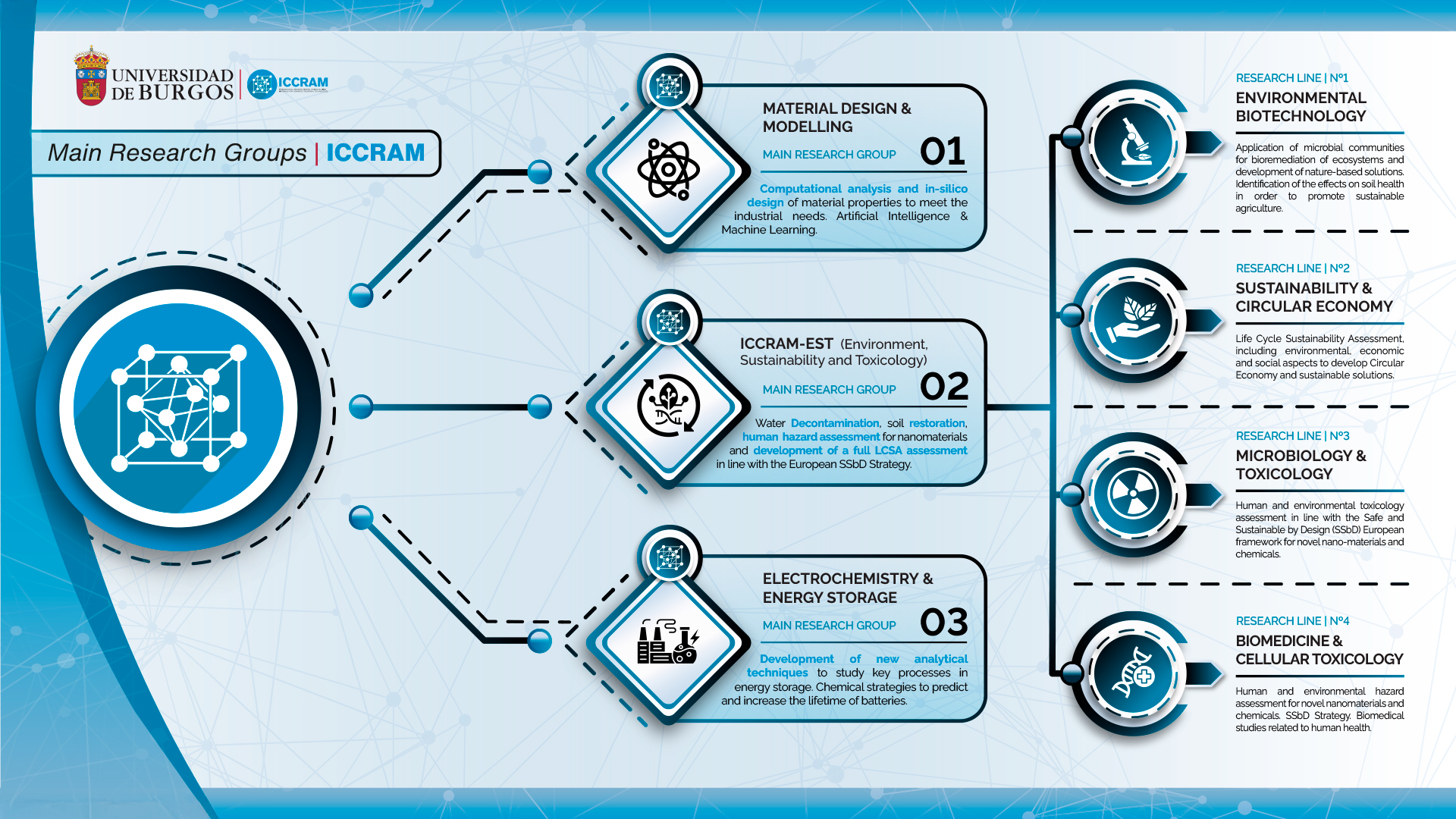
Accessible version of ICCRAM's Organisation Chart Infographic (3.72 MB)
European Framework
ICCRAM actively participates in numerous European projects funded through the European Framework Programmes for Research and Innovation, such as Horizon 2020 and Horizon Europe. These initiatives allow the Center to contribute to advancing scientific excellence and tackling global challenges. Among its activities, ICCRAM has taken part in prestigious schemes such as the Marie Skłodowska-Curie Actions (MSCA), which promote researcher mobility and training; the highly competitive FET OPEN programme, which supports breakthrough and high-risk interdisciplinary research; as well as initiatives within the NMBP Programme (Nanotechnologies, Advanced Materials, Biotechnology and Advanced Manufacturing) and Societal Challenge 5, focused on climate action, environment, resource efficiency, and raw materials.
Beyond project participation, ICCRAM is recognized as a key international actor in several strategic networks and organizations. It is an active member of PROMETIA, an association fostering innovation in mineral processing and extractive metallurgy; the European Innovation Partnership on Raw Materials (EIP Raw Materials), which aims to secure sustainable access to raw materials in Europe; the Nanosafety Cluster, dedicated to ensuring the safe and responsible development of nanotechnologies; and the Association of Nanotechnology Industries, which promotes collaboration and innovation within the nanotech sector. Through these platforms, ICCRAM not only contributes cutting-edge knowledge but also strengthens Europe’s leadership in sustainable technologies, advanced materials, and safe innovation.
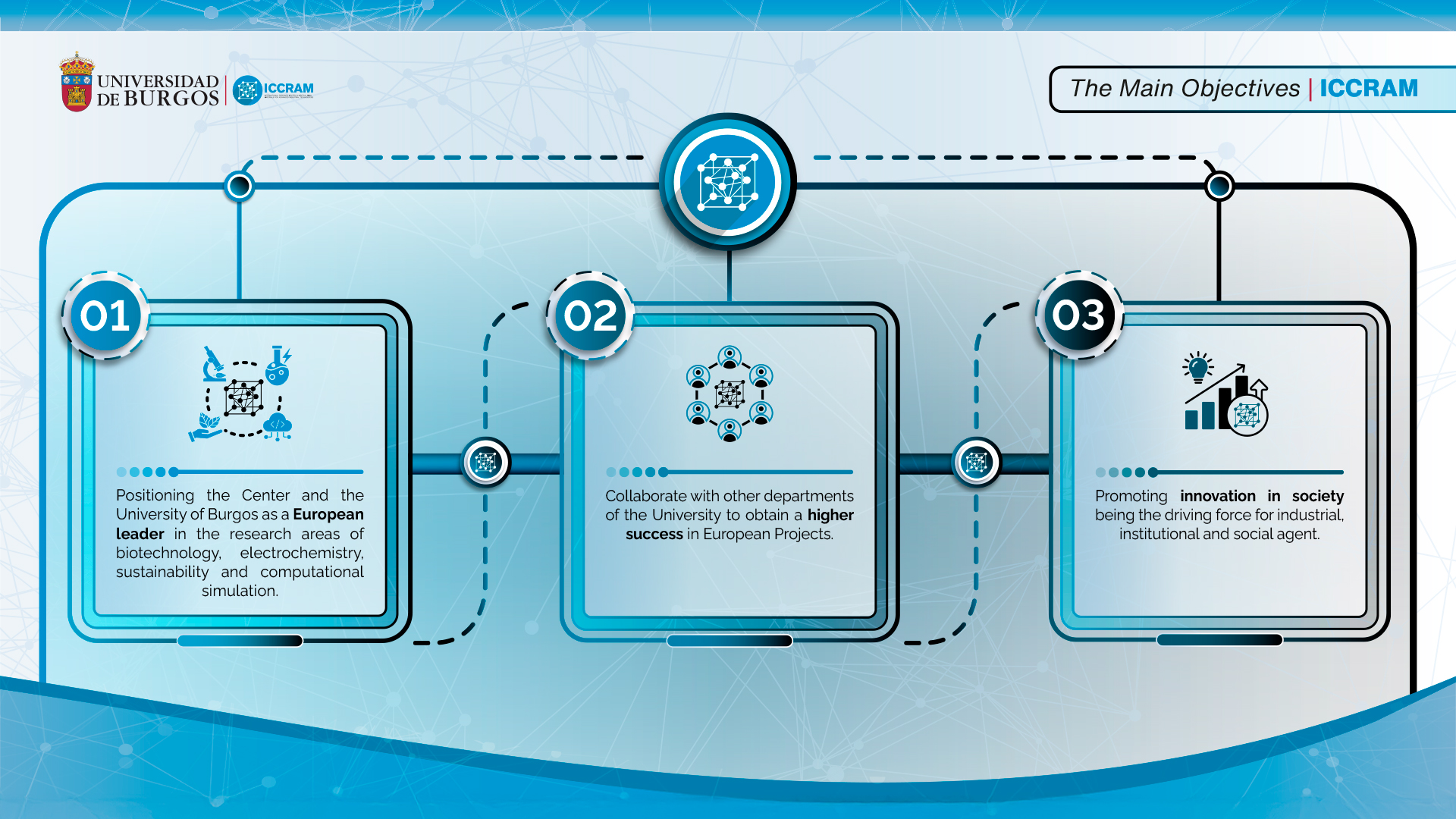
Accessible version of the ICCRAM's objectives infographic (2.00 MB)
Main Objectives of ICCRAM:
Positioning the Center and the University of Burgos as a European leader in strategic research areas
ICCRAM aims to consolidate itself as a hub of scientific excellence in key fields such as biotechnology, electrochemistry, sustainability, and computational simulation. By fostering high-impact research, generating advanced knowledge, and transferring results to industry and society, the Center seeks to place both ICCRAM and the University of Burgos at the forefront of European research. Active participation in international networks and contribution to global challenges are essential pillars of this objective.Fostering interdisciplinary collaboration within the University of Burgos
A central element of ICCRAM’s strategy is to work closely with other departments and research groups of the University, creating synergies that strengthen proposals in European funding calls. This internal cooperation enhances competitiveness and success rates in large-scale projects, while promoting interdisciplinarity and leveraging complementary expertise across diverse scientific areas.Promoting innovation and acting as a driving force for industrial, institutional, and social transformation
ICCRAM’s mission is to transfer scientific knowledge to the productive sector and institutions, contributing to the development of innovative solutions that address today’s challenges in sustainability, technology, and quality of life. In this sense, the Center plays a key role as a catalyst, bridging academic research with the needs of industry, public bodies, and society at large. Its goal is to foster responsible innovation and support the transition towards a more sustainable and competitive future.
Accessible version of ICCRAM's introductory infographic (1.82 MB)
Videos
Última actualización: 1 de Septiembre de 2025


