


Joint Research Unit for Hydrogen Technologies
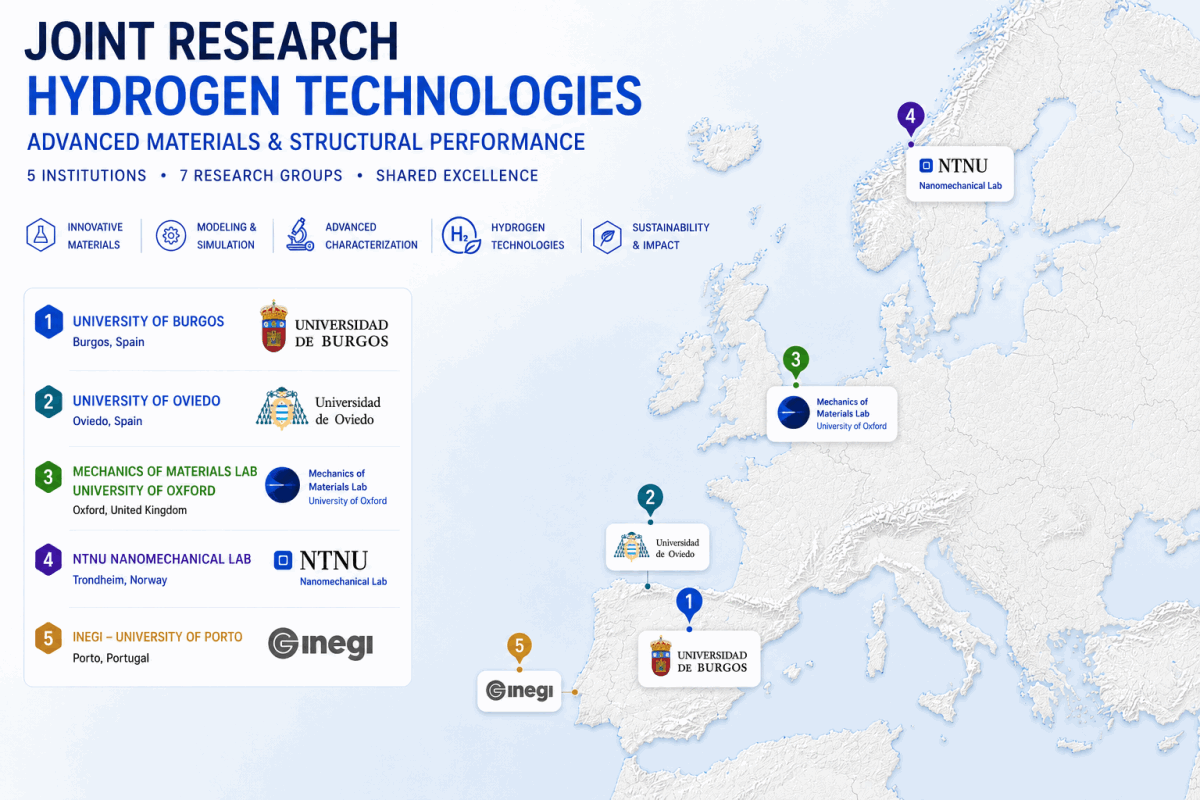
Research Team (both national and international):
- Grupo de Integridad Estructural (University of Burgos)
- Grupo de Polímeros (University of Burgos)
- Grupo Amido-Ruca (University of Burgos)
- Simulación Numérica, Modelización, Caracterización Mecánica y Optimización Microestructural de Componentes Industriales (Universidad de Oviedo)
- Mechanics of Materials Lab (University of Oxford)
- Nanomechanical Lab (Norwegian University of Science and Technology NTNU, Trondheim)
- Materials and Manufacturing Processes (INEGI, University of Porto)
Coordination:
- Coordinator: Andrés Díaz Portugal
- Research Group: Grupo de Integridad Estructural
- Departament: Ingeniería Civil
Motivation and context:
The success of hydrogen as an energy vector alternative to fossil fuels requires support to research into related technologies (production, storage, transport and use). Hydrogen plays a pivotal role for energy decarbonisation within the recovery plans of the European Union (NextGen), focused on the new Green Deal. The EU sets a target for 2050 that at least 13-14% of the energy mix should be based on renewable hydrogen. In addition, to materialise these investments from European funds, the European Clean Hydrogen Alliance has been created, being the UBU an active member.
The Spanish Strategy for Science, Technology and Innovation (2021-2027), also considers hydrogen energy and fuel cells as strategic topics in the R&D line "Climate change, decarbonisation and sustainable transport" and the application of hydrogen renewable energy is a key point in the "Advanced materials and new production techniques" line. Similarly, hydrogen technologies will be crucial in the decarbonisation and decentralisation of energy in the region, objectives that belong to the section of the RIS3 2021-2027, "Castilla y León, carbon neutral and fully circular".
Within this context, the Structural Integrity Group in the University of Burgos has a recognised experience in research on the behaviour of materials and the structural integrity of components in contact with hydrogen, carrying out different national and international collaborations with prestigious groups. Therefore, it is considered now, more than ever, necessary to promote this research, with special emphasis on the dissemination to the general audience and the industrial sector of all activities around hydrogen technologies (publications, conferences, seminars, capabilities, services to companies, patents, etcetera). The creation of this Joint Research Unit will enhance the collaboration between the groups involved, give visibility to the transfer of research and improve the international position of the UBU as a promoter of hydrogen technologies.
Scope:
The Joint Research Unit for Hydrogen Technologies (JRUH2T) gathers different groups from the University of Burgos with national and international collaborators from different sectors. All groups are actively involved in research lines that concern the hydrogen value chain, including production, transport, storage and use.
Some members of the JRUH2T are oriented to the design and analysis of systems handling high-pressure gaseous hydrogen. Alloys and composites for H2 compressors, pipelines or storage tanks need to be characterised in order to prevent or predict hydrogen-induced degradation. These involved groups have a recognised expertise in structural integrity, hydrogen embrittlement, material science, metallurgy, chemo-mechanical characterisation, high-performance polymers, etcetera, although some groups focus on a more experimental approach and others are centred in the numerical simulation of hydrogen-related phenomena. Through these collaborations, the scientific challenge around hydrogen embrittlement in real H2 systems can be tackled while their design, material selection and cost are optimised. Therefore, a two-fold approach is considered in the JRUH2T: a breakthrough in the understanding of hydrogen-material interaction is searched, and the practical application of this knowledge is applied to H2 compression, transport and storage systems. On the other hand, the JRUH2T also gathers research groups focused on other hydrogen topics including electrolysis, decision support tools for hydrogen networks or catalysis for the production of green ammonia or in fuel cells.
Facilities
- Hydrogen Technologies Laboratory (H2Lab). The HPHT-H2 (High Pressure, High Temperature, H₂ Atmosphere) testing system, featuring an integrated autoclave for high-pressure and high-temperature hydrogen environments, is a unique equipment that enables a wide range of standardized tests to evaluate the mechanical properties of different materials under high-pressure, high-temperature gaseous hydrogen conditions. These tests include tensile testing (using smooth or notched specimens), fracture testing, and fatigue testing.
Projects/dissemination
Hydrogen Embrittlement mitigation through Layered diffusion patterns in Metals (HELMet)


Hydrogen embrittlement (HE) of metallic materials is one of the main challenges for the adoption of green H2 as a clean fuel. Degradation of pipelines and vessels is nowadays avoided by conservative design and material selection, but novel mitigation strategies for hydrogen embrittlement will foster cost-effective technologies. I envisage an Additive Manufacturing strategy to tune hydrogen diffusion as an effective and novel method to mitigate or even supress HE. The success of this framework requires the reconsideration of modelling and experimental techniques to characterise hydrogen transport and embrittlement in metals. My background on computational mechanics, hydrogen diffusion simulation and Laser Powder Bed Fusion (LPBF) will guide the approach whereas the methodology will be enriched by innovative phase tailoring strategies and advanced computational and optimisation procedures.
Tailoring hydrogen diffusion in steels will be accomplished by exploiting the enormous difference in diffusivity between fcc and bcc iron phases. Duplex Stainless Steels (DSS) that combine austenite (fcc) and ferrite (bcc) phases are thusconsidered as a first option to tune diffusion paths. Additionally, localized nitrogen evaporation to directly control fcc or bcc formation during micro-LPBF of High Nitrogen Steels (HNS) will be achieved by local variation of laser parameters.
The main goal is to protect critical regions and therefore to supress hydrogen-assisted cracking. To produce shielding effects around stress concentrators, bcc/fcc “helmets” will be optimised by coupled modelling frameworks including hydrogen transport and fracture. Trapping and multiphase diffusion will be assessed by novel modelling procedures from thermal desorption and permeation experimental results. Finally, the effectiveness of the optimised tailored helmets will be evaluated by in-situ testing in gaseous H2, paving the way for resistant components to transport and store highpressure
National scientific congress
- A. Díaz: “On the calibration of ductile Phase Field models for Hydrogen Embrittlement based on fracture tests". Congress on Numerical Methods in Engineering 2026. Gijón. July 1–3, 2026
- V. Arniella. “Efecto de la velocidad de impresión en los defectos y la respuesta mecánica en hidrógeno de un acero 316L fabricado por LPBF”. CNMAT. Portugalete. 16-19 junio 26.
- A.E. Gómez-Ovalle∗, R. Tamayo-Perdiguero, A. Díaz. Anisotropic Phase-Field Fracture under Hydrogen Embrittlement. “Structural Tensor Calibration and Numerical Validation.” GEF 2026 · 42nd Spanish Fracture Group Congress. Aranjuez 11-13 marzo 2026
- R. Rodríguez-Aparicio, I.I. Cuesta, J. M. Alegre, A. Díaz. “Caracterización experimental de la conductividad eléctrica en un acero x60 y modelado phase field del crecimiento aparente de grieta medido mediante DCPD”. Congreso Grupo Español de Fractura. Aranjuez. 11-13 marzo 2026.
- R. Tamayo-Perdiguero, A.E. Gómez-Ovalle, V. Arniella, A. Díaz, R. Rodríguez-Aparicio, I.I. Cuesta. “Modelización de la fractura de aceros inoxidables dúplex anisotrópicos sometidos a hidrógeno a alta presión”. 42 Congreso del Grupo de Fractura 2026. Aranjuez, del 11 al 13 marzo de 2026
Scientific publications
Shiyuan Yang a, Andrés Díaz b, Abílio M.P. De Jesus a, Debiao Meng c d, Shun-Peng Zhu c d. Machine learning-assisted intelligent identification of hydrogen trap information in temperature-programmed hydrogen desorption. Engineering Failure Analysis. 1 December 2025. Article: 110180. Volume 182, Part C
Press
- El ingeniero Andrés Díaz Portugal logra el único ERC Starting Grant de Castilla y León
- Un burgalés en la élite de la investigación en tecnologías del hidrógeno verde
- «Queda mucho por hacer para retener el talento»
- PERSONAJES ÚNICOS / ANDRÉS DÍAZ PORTUGAL. Talento emergente para la investigación Burgos
Funded by
The European Union, ERC-2024-StG. Project 101165414-HELMet. Views and opinions expressed are however those of the author(s) onlyand do not necessarily reflect those of the European Union or European Research Council. Neither the European Union nor the granting authority can be held responsible for them.
Última actualización: 31 de Julio de 2026


